
Empowering Classrooms: OpenAI Introduces Specialized AI Plugins for Students and Educators
OpenAI has introduced three specialized plugins for K–12 teachers, college educators, and students to enhance classroom learning and academic planning. These tools are integrated into ChatGPT Edu and ChatGPT for Teachers, focusing on reasoning, project execution, and personalized education while maintaining high data privacy standards.
RMN Digital Education Desk
New Delhi | August 6, 2026
As students and educators return to classrooms this fall, OpenAI is shifting the role of artificial intelligence from a simple question-and-answer tool to a reasoning system capable of executing complex, multi-step academic work. To support this evolution, OpenAI has launched three new education plugins for ChatGPT Work and Codex, specifically tailored for K–12 educators, college faculty, and higher education students.
Agentic Tools for Every Level of Learning: These plugins serve as packages of role-specific skills and workflows that allow users to leverage AI without needing to construct complex prompts. By connecting to existing documents, course materials, and calendars, the plugins provide a context-aware experience that moves from initial curiosity to practical execution.
- The K–12 Educator Plugin: Developed alongside teachers, this tool assists in creating differentiated resources and interactive visuals. It integrates with Learning Commons to ensure materials align with local academic standards and learning progressions while keeping teachers in control of pedagogical decisions.
- The College Educator Plugin: This tool streamlines academic planning by helping faculty update syllabi, adapt materials for diverse learners, and package content for Learning Management Systems (LMS). It also integrates with research tools to support faculty across their teaching and professional duties.
- The College Student Plugin: Designed to foster deeper understanding, this plugin acts as a guided tutor. Students can create personalized study guides, quizzes, and interactive explanations from their own selected sources, helping to build stronger study habits based on learning science.
Commitment to Privacy and Professional Development: OpenAI continues to prioritize secure, institution-managed environments. ChatGPT Edu and ChatGPT for Teachers provide enterprise-level privacy, administrative controls, and protections to support FERPA (Family Educational Rights and Privacy Act) requirements.
Also Read:
[ New Picture Book Makes Artificial Intelligence Fun and Accessible for Kids ]
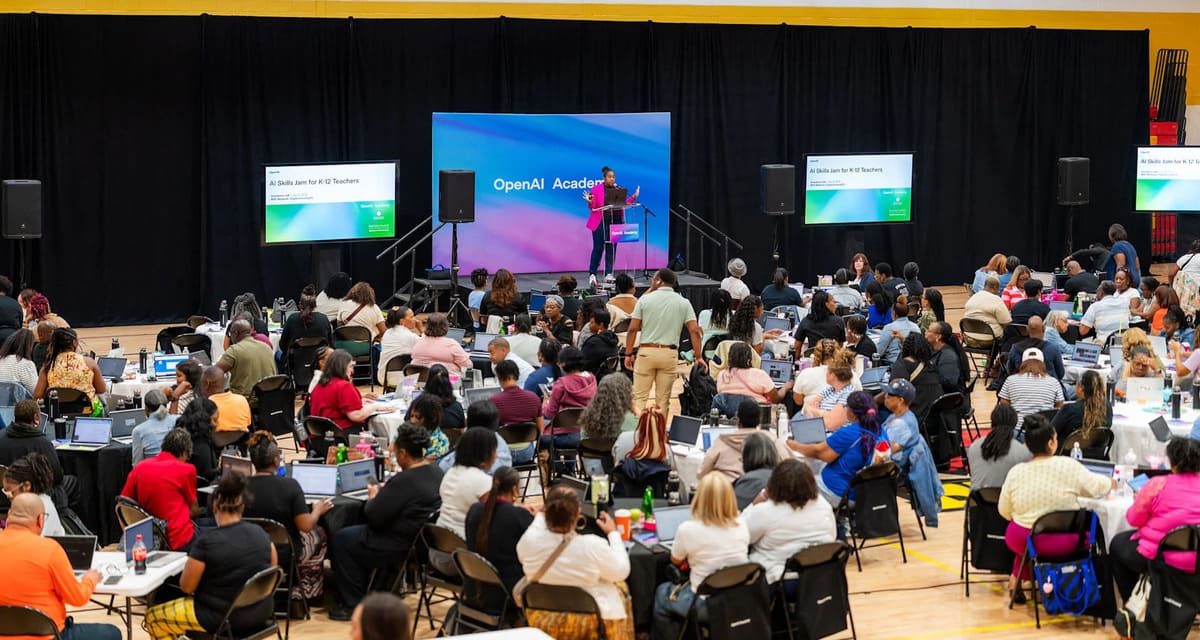
Beyond software, OpenAI is investing in the human element of education. Through a partnership with the American Federation of Teachers (AFT), OpenAI is a founding partner in the National Academy for AI Instruction, which aims to equip 400,000 K–12 educators with the skills to lead AI integration in their schools. Additionally, the OpenAI Academy and the OpenAI Student Collective are fostering peer-led communities to bridge the “capability overhang”—the gap between what AI can do and how students currently use it.
A Vision for Student Agency: The ultimate goal of these advancements is to help students develop agency: the ability to direct AI tools toward meaningful goals, solve hard problems, and turn ideas into reality. By providing structured access through ChatGPT Edu, OpenAI is helping students move toward “power-user” behaviors in analysis and calculation, ensuring that AI use leads to genuine opportunity and achievement.