
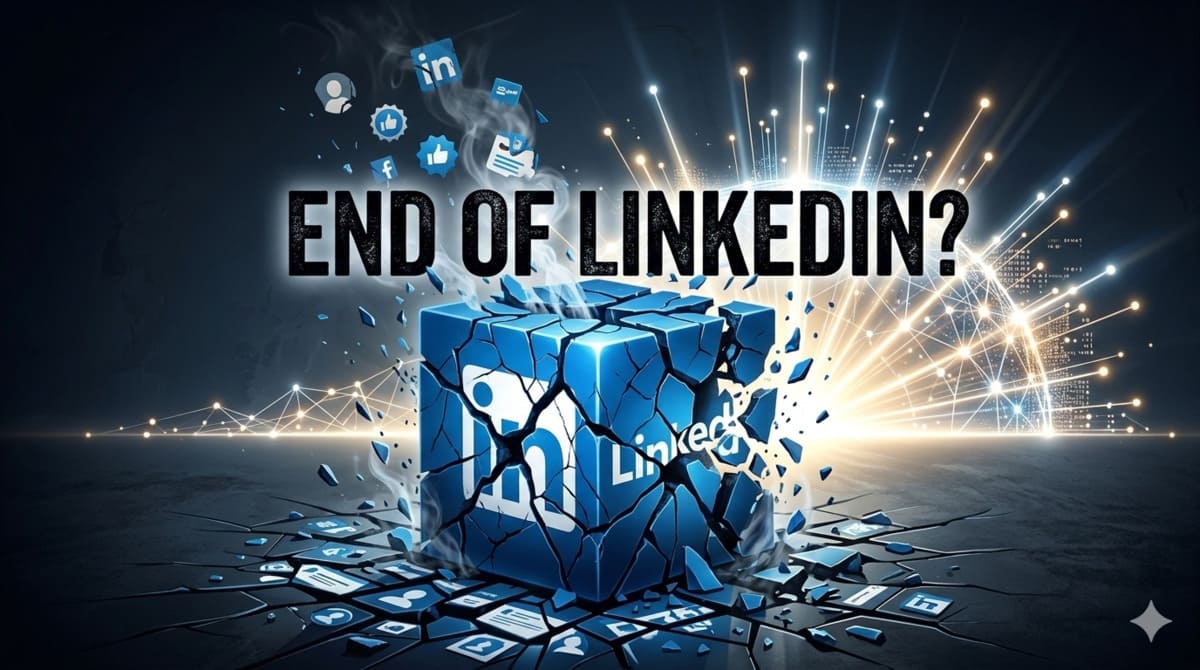
The Death Knell of Legacy Social Media: Inside LinkedIn’s Systemic Delinquency and Technical Decay
LinkedIn is currently struggling with catastrophic backend failures and an administrative “hibernation” that leaves professional users stranded. As the platform fails to address critical technical delinquency, the rapid expansion of AI-driven advertising models from OpenAI suggests a terminal shift in the digital landscape.
LinkedIn’s Systemic Decline: Technical Failure and the Rise of AI
By Rakesh Raman
New Delhi | June 13, 2026
1. The Breakdown of Professional Infrastructure
In the high-stakes world of digital news, independent publishers do not view professional networks as mere social utilities; they are the essential pipelines of the modern economy. For a journalist or a strategist, technical stability is not a luxury—it is a critical business necessity. When a platform’s infrastructure fails, it is more than a nuisance; it is a “silent technical assassination” of professional distribution.
In recent days, specifically originating from users in New Delhi, the platform has exhibited a severe breakdown in core routing logic. Investigative analysis reveals a “backend loop” where simple interactions—such as clicking the “Start a post” field—trigger a system panic that terminates the session. More alarmingly, LinkedIn is suffering from an absurd DNS or routing failure where official LinkedIn Company Pages are being misdirected to external Facebook pages. This is not just a bug; it is a catastrophic loss of domain control where a direct competitor, Meta, is receiving traffic from LinkedIn’s own architecture.
Critical System Failures
| Observed Glitch | Impact on User Workflow |
| “Start a post” logout loop | The platform refuses text input and forcefully terminates sessions, creating a dead-end experience that forces platform abandonment. |
| Company Page routing error | Directs professional brand traffic to external Facebook profiles, signaling a total collapse of domain mapping and brand integrity. |
| Lack of diagnostic messaging | The system crashes silently without error codes, intentionally obstructing the user’s ability to troubleshoot or recover. |
These failures represent a systemic delinquency that halts daily professional operations, effectively de-platforming voices through technical neglect.
When a platform claims to be the ‘world’s largest professional network’ but operates with the administrative transparency of a ghost town, it forfeits its right to host the global business conversation.
2. “Deflection as a Service”: The Support Crisis
The health of a platform is best measured by the integrity of its support ecosystem. When a network is in terminal decline, its support transitions from engineering-led problem solving to “Deflection as a Service.” LinkedIn has entered a state of administrative hibernation, trapping users in an “automated purgatory” where human intervention is non-existent.
🔊 Systemic Decline of LinkedIn: Audio Analysis
LinkedIn’s “Lazy Fallback” strategy—casually suggesting that users clear their “cache and cookies”—is a diagnostic failure of the highest order. If local browser data were truly capable of causing such severe, server-side routing mayhem, it would suggest that browsers like Chrome and Firefox require fundamental reform rather than the platform itself. Methodical testing across multiple browsers confirms these issues are localized within LinkedIn’s failing augmented tech infrastructure, not the user’s hardware.
A user will literally collapse from exhaustion trying to locate a needle in their maze of generic text.
The LinkedIn Help Center Experience:
- Digital Jungle: A vast expanse of generic text designed to exhaust the user rather than provide clarity.
- Convoluted Maze: Navigation that prioritizes user fatigue over issue resolution.
- Lack of Transparency: A refusal to provide official case ticket numbers or real-time engineering updates.
This absence of human-led support is a direct symptom of a larger existential threat: LinkedIn is withholding engineering resources (OPEX) to manage its own structural obsolescence.
3. The Macro Shift: AI vs. Legacy Social Media
We are witnessing the “terminal platform decline” of legacy social media as they struggle to compete with OpenAI’s aggressive global expansion. The strategic shift toward conversational advertising represents a direct assault on the clunky, often dysfunctional models maintained by aging giants. LinkedIn’s current “hibernation” suggests they have seen the writing on the wall and are choosing to let legacy systems decay rather than reinvest in a dying product.
The roadmap for this transition is clear and categorized by a two-wave assault on legacy advertising markets:
AI Market Expansion Timeline
- March 2026: Initial international expansion of the ChatGPT ads pilot into Canada, Australia, and New Zealand.
- May 2026: Massive scaling into five additional Tier-1 markets: The United Kingdom, Mexico, Brazil, Japan, and South Korea.
As advertisers migrate to these intelligent conversational interfaces, legacy platforms are facing the reality of workforce layoffs and backend abandonment. The “lack of error messages” on LinkedIn is likely a literal reality: there may be no one left to write the code for them.
4. The Real-World Cost to Independent Journalism
Platform delinquency is a modern form of censorship through negligence. By allowing its technical infrastructure to rot, LinkedIn is actively blocking the dissemination of critical intelligence and independent news.
This impact is felt immediately by specialized publications that have been paralyzed by these persisting failures.
Impacted LinkedIn Newsletters and Sites:
- Technophile | Tech Insights: A primary source for global technology content.
- Movie Mate: A vital hub for global entertainment intelligence.
When a platform claims to be the “world’s largest professional network” but misdirects its own users to Facebook, it has forfeited its right to host the global business conversation. Independent journalism will thrive only by migrating away from these decaying walls and toward the stable, AI-driven frameworks of the future.
5. Editorial Conclusion and Author Insight
The transition from legacy social media to AI-integrated networking is no longer a projection—it is an active migration. LinkedIn’s technical decay and lack of administrative transparency signal the end of the traditional social silo.
June 14, 2026 Update: Corporate Apathy and the Premature “Case Closed”
In a shocking display of administrative negligence, LinkedIn Trust and Consumer Support Consultant Adil responded to my detailed technical diagnostics by prematurely closing my official ticket (Case #: 260613-002769) without fixing a single thing.
While LinkedIn openly admitted that my “diagnostic insights, including the workaround, are extremely valuable” and confirmed that my primary homepage functionality is profoundly broken, the platform declined to offer an immediate remedy. Instead of deploying a Tier-2 engineer to repair the corrupted server-side script on my profile, LinkedIn casually filed my structural system failure away as passive “feedback” and closed the case file. They essentially told me to rely on my manual “New Tab” workaround indefinitely while pointing me toward a generic corporate product blog.
As a working journalist, I completely reject this blatant platform delinquency. I have officially forced the ticket back open, demanding that LinkedIn take accountability for its broken infrastructure rather than sweep user errors under the rug. The struggle against obsolete, algorithmic corporate neglect continues.
June 15, 2026 Update: Independent User-Driven Fix Bypasses Broken Core Code
Despite continued silence from LinkedIn’s support desk after I forcefully reopened my tracking ticket, my ongoing technical investigation has yielded a complete functional bypass. While the primary “Start a post” field on LinkedIn’s main newsfeed interface remains completely non-functional—continuing to crash browser sessions—I discovered that navigating to my personal profile page provides a separate, functional “Create a post” option. By bypassing the primary newsfeed layout script entirely, I am now able to successfully resume full article distribution and newsletter workflows. This operational victory proves conclusively that the malfunction is a localized script error on LinkedIn’s primary landing dashboard, which the platform’s support staff remains slow to address.
June 18, 2026 Final Update: Total Resolution and Corporate Capitulation
On June 15, LinkedIn Support sent an explicit admission that the platform’s infrastructure was at fault. In a message from support consultant Adil, the platform requested direct permission to access my account from the backend to investigate the malfunction—completely dismantling their previous claims that my browser cache was to blame.
I chose to leave their request unanswered, letting my public technical diagnostics stand on their own merit. Today, June 18, LinkedIn quietly deployed a backend server fix. My primary personal account homepage is now fully operational; the “Start a post” button functions normally without crashing, and my core feed distribution has been completely restored.
This multi-day saga serves as a definitive case study for independent web publishers. It proves that by using rigorous analytical logic, refusing to accept lazy automated corporate scripts, and maintaining public media pressure, an independent journalist can force a multi-billion-dollar platform to fix its broken architecture.
Disclosure: I, Rakesh Raman, author of this article and founder of rmndigital.com, am the direct victim of the LinkedIn service failures detailed above. All efforts to resolve this issue through official channels were ignored; LinkedIn’s public-facing customer support emails are completely non-operational, and multiple urgent compliance requests sent directly to the official @LinkedInHelp handle on X (Twitter) have completely fallen on deaf ears. As of publication, my professional account remains non-functional, and no official case ticket number or timeline for a fix has been provided by the platform.
About the Author: Rakesh Raman is a national award-winning technology journalist and the editor of RMN news sites. He formerly contributed a regular technology business column to The Financial Express (part of The Indian Express Group) and served as a digital media expert for the United Nations Industrial Development Organization (UNIDO). He is currently an authority on Artificial Narrow Intelligence (ANI) and Artificial General Intelligence (AGI) frameworks, operating the CAIO (Chief AI Officer) Hub on RMN Digital.