

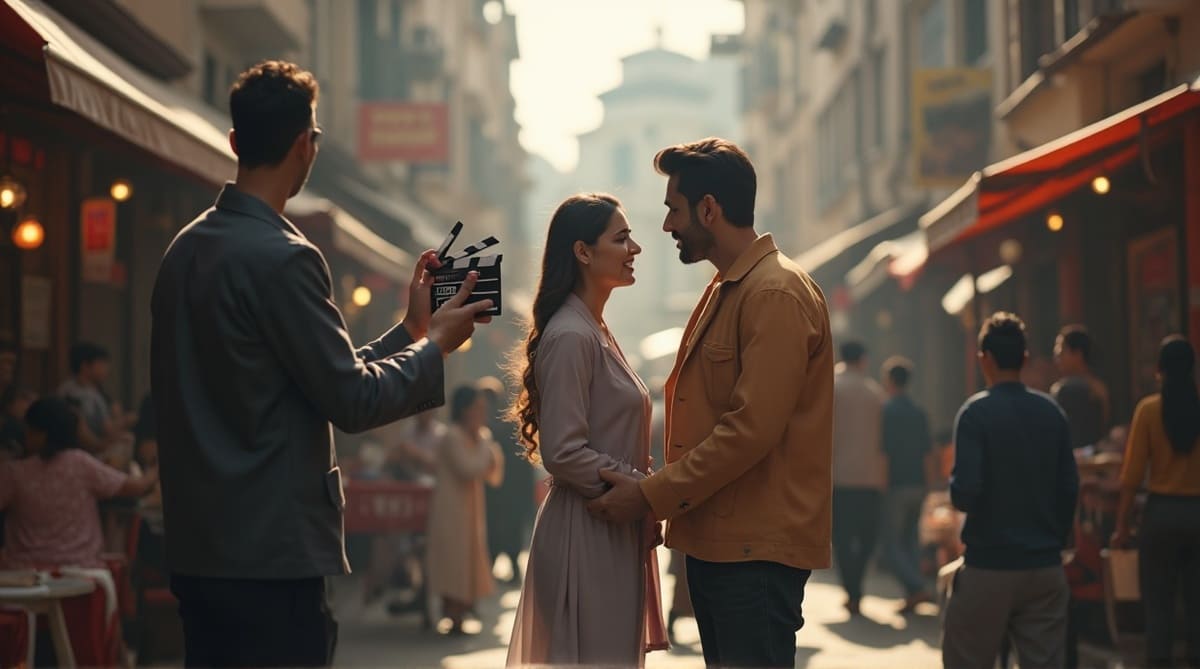
The 2028 Cinematic Pivot: How AI is Re-Engineering the Global Film Industry
The global film industry has reached a point of no return in its transition to AI-integrated production pipelines, with the market on track to hit USD 4.6 billion by 2030. Despite the optics of public labor resistance, the “settled law” established by the Supreme Court in early 2026 and the silent surge in private studio infrastructure have cleared the runway for the first commercially viable, fully AI-generated feature films to debut by late 2028.
By Rakesh Raman
New Delhi | July 4, 2026
1. The Historical Context: Technology Waves and Institutional Resistance
Artificial Intelligence is not a disruption of cinema’s legacy; it is its latest computational evolution. In the 130-year history of the medium, technological progress has never been successfully halted by institutional self-preservation. From a strategic perspective, AI must be viewed as an advanced interface for “execution” rather than a replacement for human “intent.” The industry has already crossed the prestige threshold: the 2025 Oscar win for The Brutalist—which utilized AI voice synthesis to grant Adrien Brody native-level Hungarian fluency—proved that AI is no longer a gimmick, but a tool for prestige-validated performance.
| Technology Wave | Resistance Argument | Industrial Outcome |
| Digital Sound (1970s-80s) | Protests over loss of “warmth” | Industry adopted completely within 10 years; analog resistance vanished. |
| Color Film (1930s-50s) | B&W was claimed to be artistically superior | Color became the universal standard; holdouts became a niche. |
| Non-Linear Editing (1990s) | Warning that digital tools would destroy the craft | NLE (Avid/Final Cut) became the only viable workflow. |
| CGI & VFX (1993-2005) | Campaigns against “fake” digital imagery | CGI now drives $500M+ blockbusters; practical-only is the exception. |
| Streaming (2007-2016) | Claims that streaming was “not cinema” | Streaming delivers >60% of global entertainment consumption. |
| AI Generation (Present) | Claims that AI threatens human creativity | Trajectory mirrors prior waves: institutional resistance followed by wholesale adoption. |
Viewing “Sovereign AI Production” as an unbroken chain of enhancements—from the CGI rendering of Terminator 2 to today’s neural networks—reveals that the underlying logic remains identical: human creative intent translated through a computational engine. This historical pattern confirms that the current era of skepticism is merely a prelude to the next industrial standard.
The $4.6B Inevitability: The AI filmmaking market is surging toward a $4.6 billion valuation by 2030. With a 23.6% growth rate and a clear four-year regulatory runway secured by the 2026 union ratifications, the first fully AI-generated feature film by 2028 is no longer a “maybe”—it is an industrial certainty.
2. The Economic Scale: Cost Compression and Market Trajectory
The transition to AI is dictated by a ruthless economic imperative. The industry has moved from “speculative” experimentation to “infrastructure” investment, with major studios re-engineering their corporate architectures to be AI-first.
Key Market Data Points:
- Market Valuation: Projected to grow from USD 1.59 billion (2025) to USD 4.6 billion by 2030.
- Studio Savings: AI generated an estimated USD 2.4 billion in savings in 2023 alone.
- CAGR: The adoption rate is 23.6%, the fastest technology curve in cinema history.
However, a critical chasm is widening in the “Cost Compression Curve.” On one side, Hollywood legacy productions like Here (2024) utilize AI for expensive, incremental de-aging to streamline traditional post-production. On the other, the indie sector is achieving total disruption; micro-budget features like DreadClub: Vampire’s Verdict have demonstrated that a full AI-generated feature can be produced for a staggering USD 400. This collapse in the “floor” of production costs is fundamentally reshaping the labor landscape, moving the industry away from manual craft and toward systemic orchestration.
The Human Operator Era: AI does not eliminate the creative professional; it destroys the gatekeeping model. By becoming “Prompt Architects,” filmmakers can bypass the traditional studio oligopoly, using AI as an execution engine that preserves human intent while collapsing production costs in markets like India from Rs 50 lakhs to just Rs 10 lakhs.
3. Labor and Legal Architecture: From Resistance to Ratification
Hollywood is currently gripped by a “Structural Paradox”: a landscape where talent maintains a posture of public skepticism while studio leadership aggressively builds private AI infrastructure. While actors like Emily Blunt publicly advocate for manual performance, studios like Netflix are acquiring firms like InterPositive to automate the very production layers the guilds seek to protect.
The June 2026 SAG-AFTRA ratification serves as the “final concession.” By explicitly permitting the use of “synthetic characters” and agreeing to a no-strike window through 2030, the union has inadvertently provided studios with a four-year subsidized R&D period. This strategic runway allows studios to perfect AI production technologies without the threat of labor disruption, essentially legitimizing AI’s permanent role in the industry.
Legal Summary: The Thaler Precedent: In March 2026, the U.S. Supreme Court denied certiorari in Thaler v. Perlmutter, making the human-authorship requirement settled law at the federal level. This ruling actually incentivizes the “Prompt Architect.” It confirms that as long as a human exercises creative control—selecting, coordinating, and arranging AI output—the human operator retains full copyright. This makes the skilled professional indispensable, ensuring that “Sovereign AI” remains a tool for the artist, not a replacement for them.
4. Technical Pipeline: The 2028 Horizon for Feature Films
We are currently navigating the “bottleneck” phase of development. The industry’s “Holy Grail” remains “temporal coherence”—the ability to maintain consistent lighting, physics, and character geometry across long-form sequences.
AI Production Stack: 2026 vs. 2028 Targets
| Production Stage | Current State (2026) | 2028 Targets |
| Scriptwriting | Tools like GPT-4o; structural drift in long scripts. | Full character-arc preservation (>5M tokens). |
| Video Generation | Google VEO 3, Runway Gen-4; clips <60s. | Stable 10-minute photorealistic sequences. |
| Audio/Performance | ElevenLabs; limited emotional subtext. | Real-time emotional modulation and breath patterns. |
| Distribution | Deepdub; quality inconsistencies in dubbing. | Near-zero cost simultaneous global localization. |
The “Base Case” for a 2028 feature film relies on meeting four milestones: temporal coherence, multi-character consistency, long-form narrative coherence, and automated assembly. These technical advances are already being pioneered by RMN Stars through “Sovereign AI” pipelines. Examples include The Smokescreen, a political thriller anchored in verified forensic research, and Robojit and the Sand Planet, which demonstrates AI’s power as an adaptation engine for legacy literary IP. These projects prove that AI serves as a capital-leveler, allowing high-quality content to bypass the Hollywood distribution oligopoly.
5. Global Democratization: The Rise of Indie AI Ecosystems
AI is dismantling the Hollywood “distribution oligopoly” by acting as a capital-leveler for emerging markets. By reducing the reliance on massive physical infrastructure, AI allows storytellers in capital-scarce regions to compete globally.
- The Indian Indie Ecosystem: Production costs in Mumbai and Hyderabad are being slashed by 60-80%. Features that once required a minimum of Rs 50 lakhs are now being produced for Rs 10-15 lakhs, effectively bypassing traditional financial gatekeepers.
- East Asian Tech-Film Corridors: South Korea and Japan are leveraging AI to rapidly monetize “Webtoon” and literary IP.
- AI allows 2D digital content to be converted into cinematic video at a fraction of the cost of traditional animation, unlocking vast libraries of intellectual property for global streaming.
This global shift toward decentralized filmmaking marks the end of the Los Angeles-centric era, replacing it with a network of AI-enabled creators who own their production means.
6. Strategic Recommendations for the New Era
The transition is no longer a question of “if,” but of who will lead the next generation of cinema. Industry leaders must move from management to mastery.
High-Impact Actions:
- Master “Prompt Architecture”: This is the core competency of the 2028 era. Professionals must learn to translate imagination into precise algorithmic instructions.
- Secure Intellectual Property: Filmmakers should document their creative direction to ensure copyright protection under the post-Thaler “settled law” framework.
- Advocate for the “NO FAKES Act”: Support federal likeness rights to create a stable, consent-based legal environment for digital replicas.
- Adopt Sovereign Pipelines: Utilize tools like those pioneered by RMN Stars to maintain control over the entire creative lifecycle.
The future of film is a human-AI creative partnership. As we approach the 2028 horizon, the most successful professionals will be those who treat AI as an instrument to be played, rather than a threat to be feared.
Download the report: You can click here to download the report: The Inevitability of Artificial Intelligence in Films — The Way Forward.
About the Author: Rakesh Raman is a national award-winning technology journalist and the editor of RMN news sites. He formerly contributed a regular technology business column to The Financial Express (part of The Indian Express Group) and served as a digital media expert for the United Nations Industrial Development Organization (UNIDO). He is currently an authority on Artificial Narrow Intelligence (ANI) and Artificial General Intelligence (AGI) frameworks, operating the CAIO (Chief AI Officer) Hub on RMN Digital.