

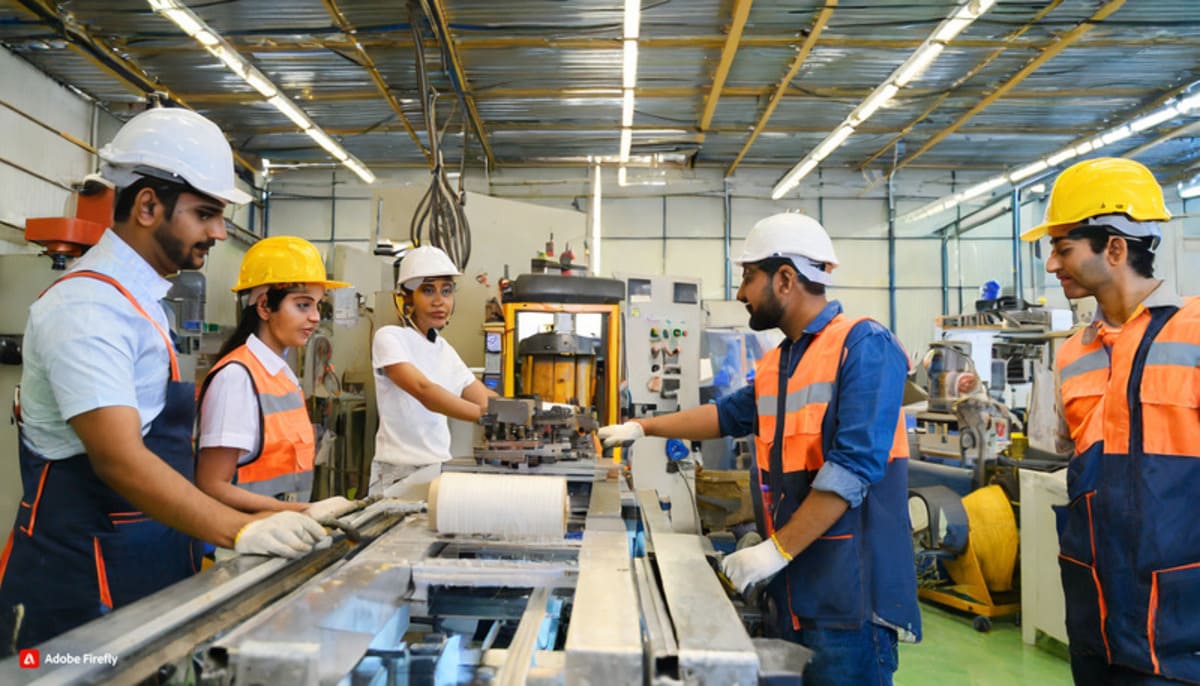
The New Industrial Revolution: A Comprehensive Enterprise Guide to AI Factories and Industrial Intelligence
AI factories are dismantling experimental silos and standardizing the production of intelligence, compressing enterprise deployment timelines from months to weeks. By fusing high-performance accelerated computing with secure networking at the edge, these refineries transform raw data into a competitive, sovereign asset, marking the transition from digital warehousing to continuous AI production.
RMN Digital Knowledge Desk
New Delhi | June 22, 2026
From Passive Warehouses to Active Refineries: Defining the AI Factory
The “AI Factory” is no longer a metaphor for high-density compute; it is the fundamental infrastructure of the agentic era. Unlike traditional data centers—which function as passive warehouses for storing and serving information—an AI factory operates as an active refinery. In this model, raw enterprise data is the fuel, and actionable, autonomous intelligence is the refined product.
NVIDIA founder and CEO Jensen Huang characterizes this shift as a “silicon-to-software” revolution. As we enter the agentic era, AI agents are evolving from simple chatbots into integrated, autonomous components of the workforce. This transition demands a move toward a software-defined architecture that protects model integrity and data privacy at every layer. For the modern enterprise, the AI factory is the prerequisite for scaling these agents from peripheral experiments to core production engines.
The Architecture of Industrial Intelligence vs. Traditional IT
| Feature | AI Factories | Traditional IT |
| Primary Workload | Continuous training, fine-tuning, and real-time inference of models. | General-purpose applications, web hosting, and static databases. |
| Core Architecture | Purpose-built for massive parallel processing (GPUs, DPUs, high-throughput storage). | Relies on general-purpose Central Processing Units (CPUs). |
| Output | Tokens, predictions, and autonomous agentic actions. | Static applications, documents, and digital records. |
| Lifecycle | Automated pipelines with continuous feedback loops. | Independent development cycles with infrequent, manual updates. |
The Five Pillars of the Intelligence Assembly Line
Building an operational AI factory requires a unified, tightly integrated stack. Corporate leaders must move beyond viewing AI as a software installation and instead treat it as a continuous assembly line comprising five critical layers:
- Accelerated Computing Hardware: The engine of the factory, utilizing dense GPU clusters (such as NVIDIA Blackwell architecture) and Data Processing Units (DPUs) to handle massive parallel workloads.
- Data Pipelines: The fuel line that ingests, cleanses, and standardizes massive streams of structured and unstructured data from across the enterprise.
- Orchestration Software: The management layer, often utilizing Kubernetes to schedule workflows and automate the model lifecycle.
- Model Development & Training: Utilizing MLOps platforms to automate the testing, evaluation, and fine-tuning of models.
- Continuous Inference: The deployment of low-latency endpoints that run models in real-time to generate predictions and execute autonomous workflows.
Decentralizing Intelligence: The Tactical Necessity of the Edge
As the demand for real-time decision-making grows in sectors like healthcare and logistics, “edge inferencing” has shifted from a luxury to a tactical necessity. Processing data where it is born eliminates the latency of backhauling information to a central cloud.
The Strategic Pivot: To survive the agentic era, organizations must stop viewing data centers as passive digital warehouses and begin treating them as active refineries that transform raw data into a continuous stream of sovereign intelligence.
To support mission-critical workloads at the edge, enterprises are adopting high-performance hardware like the NVIDIA RTX PRO 4500 Blackwell Server Edition. This technology provides the necessary compute density for AI tasks without the massive energy footprint or specialized liquid cooling requirements typically associated with massive data centers. By moving intelligence to the edge, organizations can maintain operational continuity in environments ranging from surgical suites to moving vehicles.
Fusing Security into the Silicon Fabric
As AI agents gain autonomy, the traditional “castle and moat” security model is obsolete. Because autonomous agents require broad data access to function, the attack surface expands, making a “fused” security approach non-negotiable.
The strategic response is offloading security policy enforcement to NVIDIA BlueField DPUs via a Hybrid Mesh Firewall. This implementation “air-gaps” the security layer from the application environment, allowing threats to be blocked at the server level before they reach sensitive data. This hardware-level offloading also preserves host CPU cycles for maximum AI performance. Governance is further strengthened by Cisco AI Defense guardrails and NVIDIA’s OpenShell platform, which allows developers to define strict operational parameters for autonomous agents.
Building the AI Grid: Standards for Global Scale
Operationalizing an AI factory requires high-bandwidth networking that can handle the massive data throughput of the agentic era. Enterprises are now standardizing their infrastructure through several key technologies:
- Next-Generation Switching: The deployment of the 102.4Tbps Cisco N9100, powered by NVIDIA Spectrum-6 Ethernet switch silicon, provides the bandwidth required for scale-out AI.
- Silicon Diversity: Customers can now choose between architectures compliant with the NVIDIA Cloud Partner (NCP) program or a Cisco Cloud Reference Architecture built on Cisco Silicon One.
- Operational Simplicity: Platforms like Cisco Nexus Hyperfabric turn complex multi-vendor integrations into manageable full-stack solutions, compressing deployment timelines from months to weeks.
Sovereign Intelligence: Global Industrial Blueprints
The rise of “Sovereign AI” is a geopolitical shift toward national digital self-reliance, ensuring data residency while fostering domestic innovation.
| Feature | Australia (Sharon AI / Sovereign AI) | India (Industrial Giants / Physical AI) |
| Infrastructure Scale | 1024 NVIDIA Blackwell Ultra GPU cluster. | Part of a $134 billion manufacturing investment. |
| Strategic Partners | VAST Data, NEXTDC, Cisco. | Reliance, Tata, L&T, Addverb Technologies. |
| Software Core | Sharon AI “Sandbox” for experimentation. | Siemens, Synopsys, and Cadence on Omniverse. |
| Key Objectives | National AI Plan alignment; data residency. | Physical AI; Digital Twins; Software-defined power. |
In India, the AI factory is fueling an industrial revolution. Havells India achieved 6x faster fluid dynamic simulations for energy-efficient designs, while Reliance New Energy is using digital twins to design clean energy “gigafactories.” Larsen & Toubro Semiconductor is even utilizing these factories to shorten design cycles for the next generation of AI chips, effectively closing the loop on hardware production.
Industrializing Intelligence: The rise of the AI factory marks a new industrial revolution where the primary output is no longer a static application, but a high-speed assembly line of automated predictions, reasoning, and actions.
Navigating the Operational Hurdles of the Agentic Era
Despite the promise of AI factories, several bottlenecks remain for the C-suite to address:
- The Power Grid Dilemma: AI training requires massive, unyielding baseload power, leading some giants to explore Small Modular Reactors (SMRs) as traditional grids struggle to keep pace.
- Capital Expenditures (CapEx): The initial investment for specialized GPUs, high-speed networking (Spectrum-6), and storage remains high.
- Data Governance: Noisy data results in “garbage in, garbage out”; rigorous curation is the only path to reliable intelligence.
- The Talent Void: Operating these automated ecosystems requires a rare blend of skills in AI architecture, MLOps, and distributed systems engineering.
Frequently Asked Questions
What is “Physical AI”? Physical AI refers to training autonomous systems—such as humanoid robots from companies like Addverb—in simulated digital environments (NVIDIA Omniverse) before they are deployed to the physical floor.
What is a “Cognitive Twin”? A Cognitive Twin is an advanced simulation platform used for massive infrastructure projects, such as the National High Speed Rail Corporation, to optimize safety and design through real-time data loops.
How does an AI factory support “Sovereign AI”? By keeping data processing and residency within national borders, AI factories allow nations to achieve digital self-reliance and comply with local security laws.
What is the “AI Grid”? The AI Grid is a managed service model that allows enterprises to consume AI as a utility—essentially “managed intelligence” delivered with carrier-grade reliability at the edge.
Conclusion: The Inflection Point of Operationalization
The global enterprise landscape has reached what Mary Johnston Turner, Global Lead at IDC, calls a critical “inflection point.” AI is moving from the laboratory to the production line. By adopting secure, high-speed AI factories, organizations are no longer just “using” AI; they are industrializing it. As the agentic era takes hold, these software-defined refineries will serve as the global standard for maintaining competitive, sovereign intelligence.