

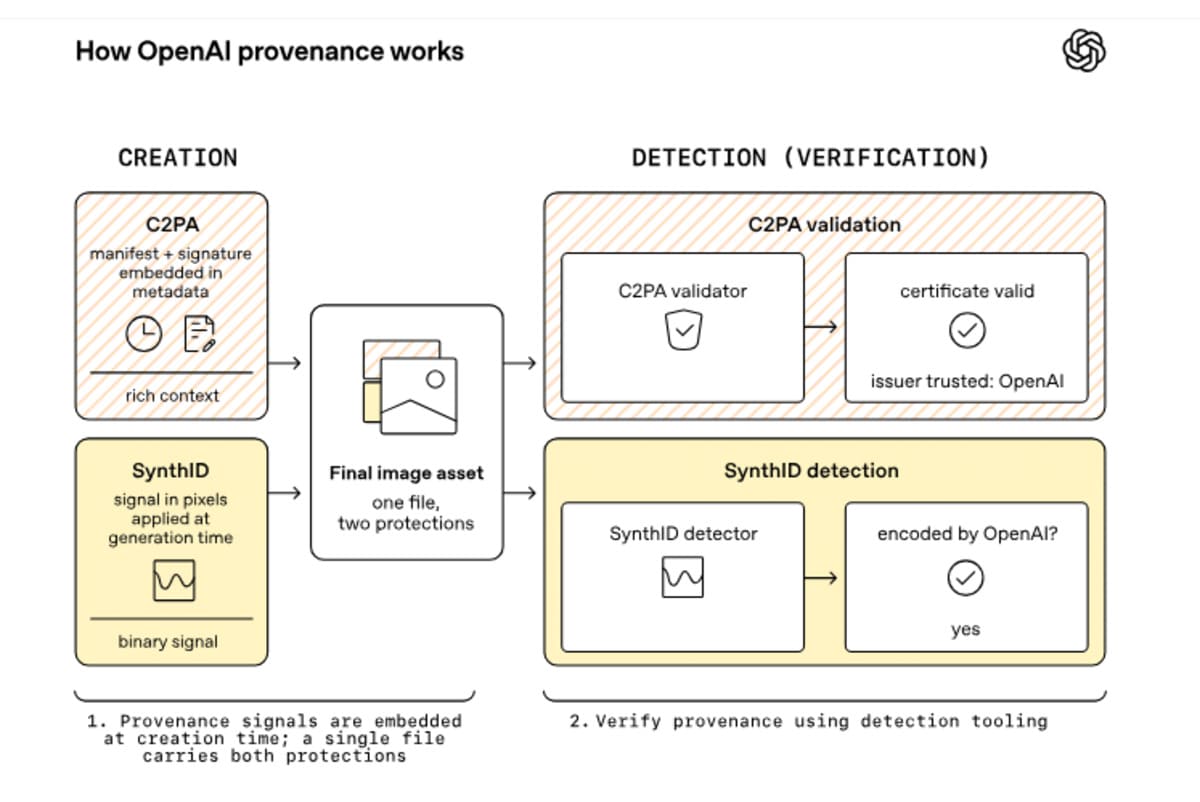
The Architecture of Digital Trust: OpenAI and the Future of Content Provenance
Forensic Proof: OpenAI’s Multi-Layered Protocol for Verifiable Content Provenance
OpenAI is transitioning to a multi-layered provenance model to ensure AI transparency and verifiable attribution. By synthesizing C2PA open standards with durable SynthID watermarking, the framework establishes a tamper-evident forensic trail across the digital content lifecycle.
By Rakesh Raman
New Delhi | May 22, 2026
1. DEFINING THE PROVENANCE PARADIGM
In the current adversarial environment of generative AI, the “origin story” of digital media has evolved from a technical footnote to a foundational pillar of digital forensics. As synthetic media generated by tools like Sora and DALL·E 3 reaches photorealistic parity with human-captured content, the ability to reconstruct a file’s chain of custody is a prerequisite for systemic security. This forensic necessity requires a shift from passive observation to active verification, ensuring that the evidentiary trail of a digital asset is both accessible and immutable.
Content provenance is the synthesis of technical signals and contextual data that allows an investigator to interpret the origin of media with high confidence. It is not merely a label; it is a verifiable record of how content was generated, edited, and signed. By providing a clear attribution chain, provenance enables journalists and automated systems to differentiate between authentic capture and synthetic generation with technical certainty.
The strategic push for attribution is necessitated by the proliferation of OpenAI’s generative suite, including DALL·E 3, Sora, and ImageGen. As these models become primary drivers of visual content, the lack of “digital nutrition labels” creates a vacuum for misinformation. Establishing a standardized forensic trail is no longer a matter of corporate policy but a technical imperative for maintaining the integrity of the digital information ecosystem.
The establishment of digital trust depends on the creation of rigorous technical standards that can be enforced across the entire industry.
2. THE C2PA FRAMEWORK: A DIGITAL NUTRITION LABEL
The industry’s primary defense against the erosion of truth is the adoption of open technical standards that provide a unified front against manipulation. The C2PA (Coalition for Content Provenance and Authenticity) Steering Committee—composed of major technological and media stakeholders—is the architect of this defense, standardizing the way provenance data is cryptographically bound to digital assets to prevent unauthorized tampering.
The Mechanics of C2PA: The C2PA framework relies on a triad of technical components to ensure the integrity of the digital record:
- Content Credentials: A standardized “digital nutrition label” that provides a verifiable history of the file, identifying the generator and any subsequent AI modifications.
- Cryptographic Signatures: Tamper-evident seals applied to the media’s metadata, ensuring that any alteration to the provenance data can be detected by forensic tools.
- Metadata: Information embedded directly into images, video, and audio files that records the specific capture device or generative model responsible for the asset.
OpenAI’s designation as a “C2PA Conforming Generator Product” represents a critical milestone in digital forensics. This status ensures that metadata is produced in a standardized format, allowing forensic tools and third-party platforms to ingest and parse provenance data without custom scripts. For the standard to be effective, it must survive “beyond the first platform,” and conformance ensures that this chain of custody remains intact as files are distributed across the web.
While metadata provides a foundational layer of context, the industry is now moving toward even more resilient, invisible protection layers.
3. MULTI-LAYERED DEFENSE: SYNTHID AND DURABLE WATERMARKING
Metadata is inherently fragile in the “cat-and-mouse” landscape of digital forensics; it is frequently stripped by social media algorithms, lost during file conversions, or destroyed via simple screenshots. To address these vulnerabilities, a multi-layered defense is required—one that moves beyond the file header and into the very pixels and frequencies of the media itself.
SynthID Mechanics: To bolster the resilience of the attribution chain, OpenAI has integrated Google DeepMind’s SynthID watermarking into content generated via ChatGPT, Codex, and the OpenAI API. Unlike C2PA metadata, which resides in the file’s wrapper, SynthID embeds an invisible watermarking layer directly into the content. This pixel-level signature is designed to survive aggressive transformations, including resizing and compression. This layered approach is further extended to audio via Voice Engine’s specialized watermarking, ensuring that synthetic voices also carry a forensic signal.
Synergistic Security: C2PA Metadata vs. SynthID Watermarking
| Feature | C2PA Metadata | SynthID Watermarking |
| Primary Function | Standardized context and edit history. | Signal durability and pixel-level survival. |
| Strengths | Comprehensive forensic data; interoperable. | Resists stripping, resizing, and screenshots. |
| Weaknesses | Vulnerable to metadata-stripping tools. | Less detailed context than full metadata. |
| Forensic Utility | Standardized ingestion for investigators. | Permanent signal for verification tools. |
By integrating these invisible signals, OpenAI provides the necessary data for the next step in the ecosystem: public verification.
4. PUBLIC VERIFICATION AND THE ECOSYSTEM OF ACTORS
The democratization of forensic tools is essential for empowering journalists and platform moderators to separate human-centric reporting from synthetic generation. Without accessible verification, even the most sophisticated provenance signals remain functionally useless to the public.
The OpenAI Public Verification Tool: OpenAI is currently previewing a public verification tool that allows for the detection of these multi-layered signals. Users can upload media to verify if it originated from ChatGPT, Codex, or the OpenAI API. The tool functions as a forensic aggregator, checking for both C2PA Content Credentials and SynthID watermarking. By integrating these disparate data points, the tool provides a high-confidence answer regarding the synthetic origin of an asset.
Industry Participants The provenance ecosystem relies on a broad coalition of actors to maintain the chain of custody:
- Generative AI: OpenAI, Google, Meta, Adobe.
- Hardware & Cameras: Leica, Nikon, Intel.
- Platforms & Media: Microsoft, BBC, LinkedIn.
This collaborative effort highlights a global shift toward an interoperable, cross-industry provenance ecosystem.
5. CHALLENGES AND AI ECOSYSTEM COMPLEXITIES
Despite these advancements, detection technology remains in a state of constant evolution. No single method is currently foolproof, and the absence of a provenance signal should not be viewed as a definitive confirmation of human origin. OpenAI maintains a “cautious approach” toward detection, recognizing that signals can be stripped by sophisticated actors or lost in legacy systems.
The current fragility of the ecosystem stems from the transition toward full interoperability. When the verification tool encounters an asset without detectable metadata or watermarks, it avoids definitive conclusions to prevent false negatives. This methodological rigor is necessary to maintain the credibility of forensic tools in an environment where malicious actors actively attempt to mask synthetic origins.
Future Trajectory: OpenAI’s roadmap involves expanding these integrity protocols to a wider range of content types and deepening cross-platform verification support. As of May 19, 2026, the industry is moving toward a standard where every piece of synthetic media carries an indelible, verifiable signature.
Final Synthesis: The integration of open standards (C2PA), durable watermarking (SynthID), and accessible verification tools represents the future of digital integrity. By moving toward a multi-layered defense, the industry is establishing a new baseline for truth in the generative age.
Unique Provenance Insights
The Digital Nutrition Label: Much like a forensic chain of custody, Content Credentials provide an immutable record of a digital asset’s history. This allows investigators and platforms to verify the “ingredients” of media—specifically identifying generative AI components—before the content is disseminated.
Resilience through Transformations: While traditional metadata is often lost during social media uploads, pixel-level watermarking like SynthID acts as a permanent forensic signature. This ensures that the origin story of an image survives screenshots, resizing, and other common digital transformations that would otherwise break the attribution chain.
By Rakesh Raman, who is a national award-winning technology journalist and editor of RMN news sites. He is presently engaged in the development of Artificial Narrow Intelligence (ANI) applications and the exploration of Artificial General Intelligence (AGI) frameworks. He contributed a regular technology business column to The Financial Express, part of The Indian Express Group. He was also associated with the United Nations Industrial Development Organization (UNIDO) as a digital media expert to help businesses leverage technology for brand development and international growth.