
Frontiers of Modern Technology: A Comprehensive Guide to 7 Breakthrough Innovations Shaping the Digital Era
Emerging technological frontiers—spanning Quantum Computing, Physical AI, Direct-to-Cell Satellite Connectivity, and Agentic Workflows—are fundamentally restructuring global digital infrastructure. These seven foundational innovations transition computing from cloud-bound, single-prompt models toward high-reasoning, autonomous, and localized execution paradigms across enterprise sectors. Understanding these core technologies is vital for leaders navigating the next decade of technological transformation and physical system integration.
RMN Digital Explainers Desk
New Delhi | November 11, 2026
RMN Digital Executive Tech Briefing
Frontiers of Modern Technology
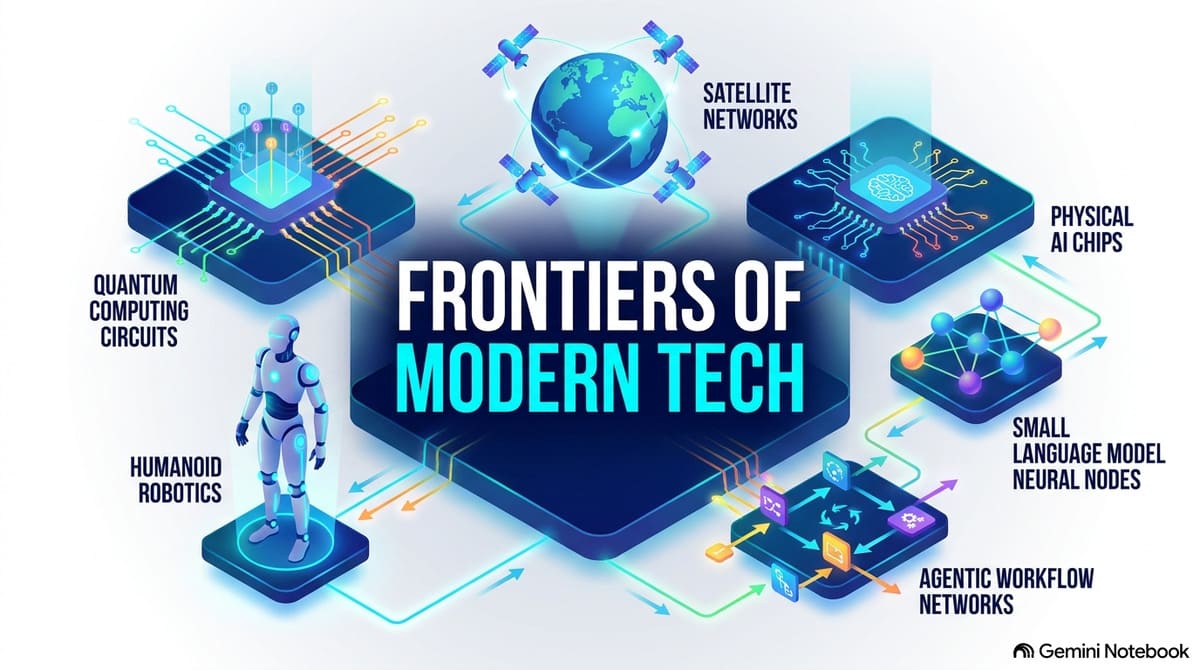
As computing paradigms evolve beyond traditional software boundaries, a new cohort of frontier technologies is redefining how data is processed, how systems interact with the physical world, and how enterprise intelligence is deployed. From subatomic calculations to orbit-to-ground connectivity, these seven technological pillars represent the core mechanisms driving next-generation digital transformation.
Frontier Technologies Overview Matrix
| Technology | Core Architectural Driver | Key Enterprise Benefit |
|---|---|---|
| Quantum Computing | Subatomic Qubits & Entanglement | Exponential Processing Speed |
| Humanoid Robotics | Bipedal Mechanics & Vision AI | Adaptable Physical Labor |
| Direct-to-Cell Satellite Connectivity | LEO Satellite Constellations | Universal Coverage (No Dishes) |
| Physical AI | Real-Time Sensor & Physics AI | Autonomous Physical Systems |
| Small Language Models (SLMs) | Sub-10B Parameter Architecture | Local, Low-Latency Inference |
| Test-Time Compute (System 2 AI) | Inference-Phase Reasoning Time | High-Accuracy Verification |
| Agentic Workflows | Goal-Driven Multi-Agent Tools | Autonomous Workflow Execution |
1. Quantum Computing
Quantum computing fundamentally departs from traditional binary computing architectures. Instead of relying on conventional transistors restricted to binary bits (representing 0s and 1s), quantum processors harness subatomic physics using quantum bits, or qubits.
Qubits leverage fundamental quantum mechanics—specifically superposition (the capacity to exist in multiple states simultaneously) and entanglement (interdependent quantum linkage across particles). This architectural shift enables quantum systems to evaluate vast combinatorial possibilities at once. Consequently, quantum computing yields exponential acceleration for complex calculations, particularly in high-density fields such as advanced cryptography, molecular and chemical simulation for drug discovery, and large-scale financial risk modeling.
2. Humanoid Robotics
Humanoid robotics pairs bipedal mechanical engineering and advanced physical actuators with multi-modal artificial intelligence vision systems. This combination allows robotic hardware to dynamically navigate environments originally engineered exclusively for human workers.
Unlike conventional industrial robotic arms engineered for rigid, single-task factory automation, humanoid platforms possess generalized spatial awareness and adaptive balance. By synthesizing computer vision with agile mobility, these platforms execute varied operational tasks—ranging from complex logistics and warehouse assembly to hazardous material handling—alongside human workforces without requiring retrofitted infrastructure.
3. Satellite Connectivity (Direct-to-Cell)
Direct-to-cell satellite connectivity establishes communications between standard, off-the-shelf cellular mobile devices and Low Earth Orbit (LEO) satellite constellations.
Unlike legacy satellite communications that depend on specialized satellite phones, terrestrial ground stations, or mounted dish terminals, direct-to-cell routing interfaces directly with standard device modems. By routing standard voice, text messaging, and Internet of Things (IoT) data directly through space-based relays, this technology eliminates traditional coverage dead zones across maritime routes, remote geographic regions, and disaster-affected infrastructure.
4. Physical AI
Physical AI represents the convergence of machine learning algorithms with physical machinery. Rather than executing isolated data processing within centralized cloud servers, Physical AI models are embedded directly inside physical devices—such as autonomous automobiles, aerial drones, spatial robotics, and industrial manufacturing rigs.
Also Read and Subscribe to:
[ Technophile | Tech Insights LinkedIn Newsletter ]
[ The Leader ]
These integrated units continuously ingest high-bandwidth real-time sensor feeds, compute real-world physical dynamics, and actuate mechanical movements instantaneously. Physical AI enables hardware to safely perceive, reason about, and physically navigate dynamic real-world environments with sub-millisecond responsiveness.
5. Small Language Models (SLMs)
Small Language Models (SLMs) are specialized artificial intelligence architectures engineered typically with fewer than 10 billion parameters. While large foundation models prioritize broad general knowledge across hundreds of billions of parameters, SLMs focus on domain-specific performance, parameter efficiency, and architectural optimization.
SLMs drastically reduce computational overhead, enabling low-cost model training and rapid deployment directly onto edge devices, local servers, or mobile hardware. For enterprise applications, SLMs deliver private, low-latency, and highly energy-efficient local inference without transmitting sensitive corporate data to external third-party APIs.
6. Test-Time Compute (System 2 AI)
Test-time compute—frequently referred to as System 2 AI—fundamentally alters how artificial intelligence processes information by shifting computational resources toward the inference phase rather than relying strictly on static pre-trained parameter weights.
By allocating extra processing cycles while generating an answer, the model gains dedicated “thinking time” during execution. During this inference period, the system performs internal tree-of-thought verification, code trial execution, and iterative self-correction. This architectural approach delivers significantly higher accuracy and mathematical reasoning on complex logical problems without inflating base model sizes.
7. Agentic Workflows
Agentic workflows transition artificial intelligence from passive prompt-and-response text generators into proactive, goal-driven execution systems. Built upon multi-agent architectures and specialized tool-use capabilities, these systems operate dynamically toward specified operational goals.
Rather than waiting for manual step-by-step human prompts, agentic workflows independently break down complex objectives: planning multi-step task sequences, querying enterprise databases, compiling and running executable code, and resolving runtime errors across software APIs. Operating with minimal human oversight, agentic workflows automate complex end-to-end business operations.
Comprehensive Technology Comparison Matrix
| Technology | Architectural Foundation | Core Mechanics | Primary Use Cases | Enterprise Impact |
|---|---|---|---|---|
| Quantum Computing | Qubits & Subatomic Physics | Superposition & Entanglement | Cryptography, Molecular Modeling | Exponential speedup on complex math |
| Humanoid Robotics | Bipedal Mechanics & Vision AI | Spatial Perception & Actuation | Assembly, Logistics, Hazardous Tasks | Flexible labor in human spaces |
| Direct-to-Cell Satellite | LEO Orbit Constellations | Direct Device-to-Space Routing | Remote Cellular, Emergency IoT | Total global connectivity footprint |
| Physical AI | Embedded Sensor & Kinematic AI | Real-Time Physics Ingestion | Autonomous Vehicles, Drones | On-device physical autonomy |
| Small Language Models | Sub-10B Parameter SLM | Specialized Edge Optimization | Private Corporate Inference | Data privacy & low-latency edge AI |
| Test-Time Compute | Inference-Phase Calculation | Tree-of-Thought & Self-Correction | High-Logic Reasoning & Code | High precision without larger models |
| Agentic Workflows | Autonomous Multi-Agent Tools | Goal-Driven Dynamic Execution | Software API & Process Automation | End-to-end operational automation |
As these seven frontier technologies mature and converge, their combined effect will accelerate the transition toward fully autonomous, hyper-connected, and resilient enterprise ecosystems. Organizational leaders who systematically integrate these architectural paradigms today will gain a decisive competitive advantage in navigating tomorrow’s intelligent digital infrastructure.