
Engineering the Future of Storytelling: Inside the AI-Assisted Pipeline of Robojit and the Sand Planet
By Rakesh Raman
New Delhi | January 29, 2026
The global entertainment industry has long relied on fragmented and expensive production models that concentrate risk late in the development process. In response to these structural challenges, the science-fiction project Robojit and the Sand Planet is pioneering an alternative approach: a manufacturing-style production pipeline that treats storytelling as a scalable system rather than a one-off artistic gamble.
A Human-Centric Foundation
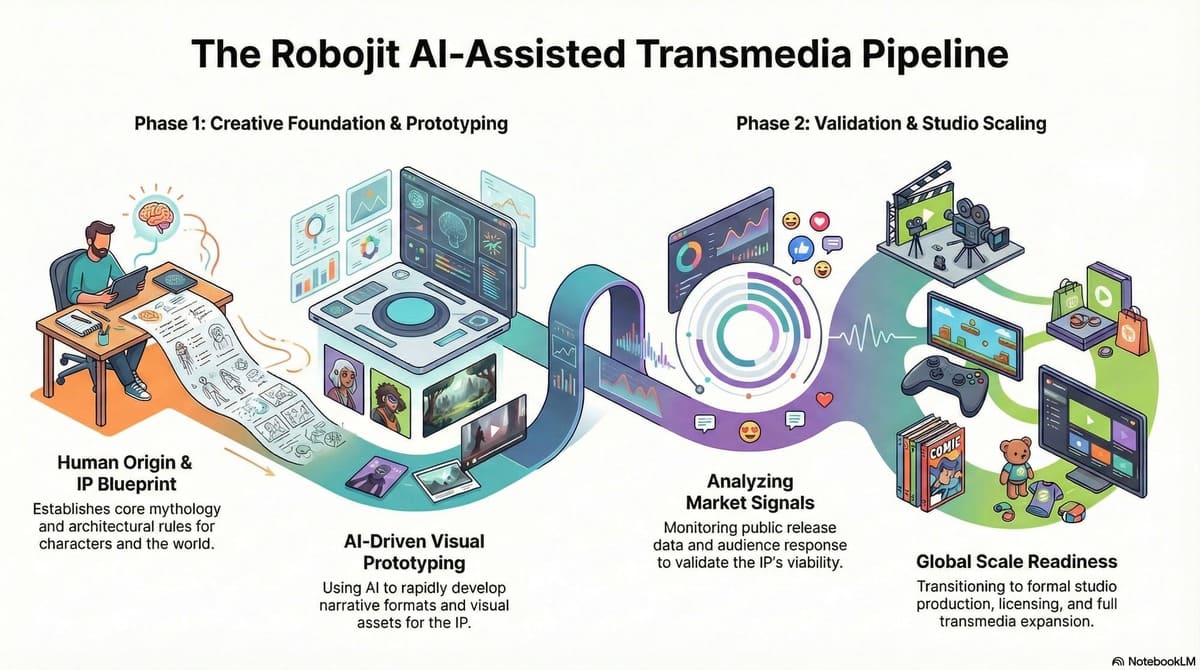
Despite the use of advanced technology, the pipeline begins with a strictly human-written novel authored over a decade ago. This creative core provides the characters, mythology, and themes that remain immutable throughout the process. A key principle of this model is that AI is applied downstream; it does not replace human authorship but instead serves as a tool to translate the original intent into various formats.
Structuring the IP Blueprint
Once the story is established, it is formalized into an IP blueprint. This stage involves defining world rules, character architectures, and narrative continuity to ensure the story can travel across diverse platforms—including film, animation, graphic novels, and interactive media—without losing its coherence. By treating the story world as structured intellectual property, the project becomes adaptable for global localization and multi-format expansion.
Rapid Prototyping and Market Validation
AI tools are introduced during the prototyping stage to offer high efficiency with minimal creative risk. In this phase, AI is used to:
- Generate visual concepts and scene interpretations.
- Convert narrative material into screenplay excerpts.
- Create graphic novel prototypes and explainer visuals.
- Experiment with multiple formats quickly and affordably.
Rather than seeking traditional “closed-door” studio greenlights, these artifacts are released publicly on websites, social media, and international editions. These releases serve as market signals, allowing the production team to observe real-time audience interest, platform response, and geographic reach before committing significant capital.
Achieving Scale Readiness
Only after the narrative has been validated through public feedback does the pipeline move toward scale readiness. Because the visual language and audience resonance have already been tested, the project is better prepared for studio partnerships, co-production models, and licensing. This transforms expansion from a “leap of faith” into a controlled, evidence-based process.
A Repeatable Model for Innovation
The ultimate goal of the Robojit project is to serve as a proof of concept for the broader industry. By applying a manufacturing mindset—characterized by clear inputs, staged processing, and early testing—this pipeline demonstrates how AI-assisted workflows can reduce costs and shorten timelines while preserving creative integrity. As the project continues to evolve in public, it offers a repeatable model for how stories can be built, not just told, in the modern media landscape.
Robojit Website | IMDb | FilmFreeway | ISA | YouTube | Twitter (X) | Facebook