

Beyond Search Boxes: How Google Is Quietly Building Your Future AI Team
The groundwork laid in 2025 with action-oriented search and workflow automation is the necessary foundation for the 2026 vision of a collaborative, multi-agent ecosystem that extends into the physical world.
By Rakesh Raman
New Delhi | December 25, 2025
It’s easy to get lost in the daily deluge of AI news, but the most profound changes aren’t always the flashiest headlines. The truly significant shifts of 2025 occurred at a deeper, systemic level within platforms like Google Labs, revealing a clear strategy: evolving AI from a collection of tools into a collaborative team.
Four Surprising Leaps from Google’s AI Labs
These four developments aren’t isolated experiments; they are interconnected pillars of a strategy to evolve AI from simple assistants into collaborative, autonomous agents.
Your Google Search Is Becoming an Agent That Acts for You
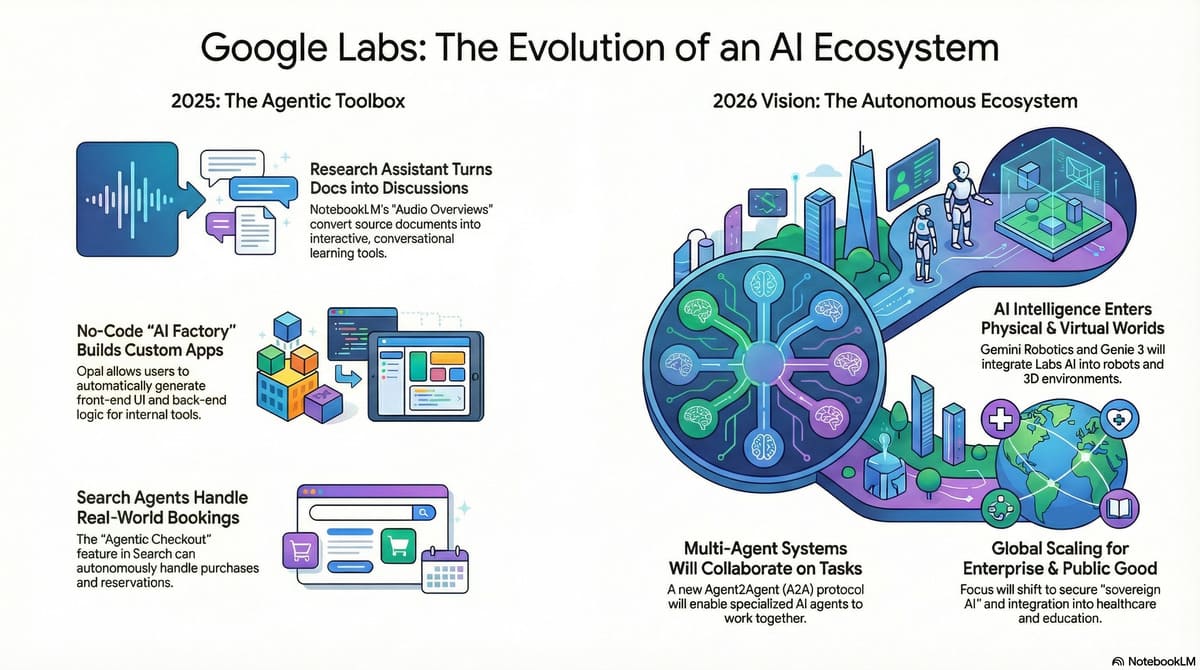
The fundamental purpose of Google Search began a significant transformation in 2025. The experimental “AI Mode” shifted the platform’s core function from finding information to taking direct action in the real world on your behalf. Enabled by a key feature called “Agentic Checkout,” the AI can now handle complete transactions like booking flights and reserving hotels directly from the search interface. This is a foundational crack in the 25-year-old paradigm of search, signaling the first step in transforming the search engine from a passive tool into an active digital teammate.
AI Is Moving from Creating Content to Automating Entire Workflows
While early AI focused on single-task generation, the next evolution is the automation of complex, multi-step professional processes. Two key examples from Google Labs illustrate this leap: Pomelli can now build “full-scale, on-brand content pipelines” for marketers, and Opal acts as a “no-code ‘AI factory'” that automatically generates both the UI and logic for internal business apps. This shift isn’t limited to business apps and marketing. Other Labs projects like Flow, an AI filmmaker, and Whisk, an image animator, show the same pattern: automating entire creative workflows, not just single tasks. This represents a higher level of automation where our AIs are becoming specialized, departmental teammates.
The Next Big Thing Is AIs Collaborating with Each Other
Looking ahead to 2026, Google’s strategy is to transform its collection of tools into an “autonomous agentic ecosystem.” This is powered by a concept called “Agentic Orchestration” and the “Agent2Agent (A2A) protocol.” Think of Agentic Orchestration as hiring an expert AI project manager. Instead of you telling the writer, the graphic designer, and the data analyst what to do step-by-step, the AI project manager directs the specialized AI agents, who use the A2A protocol to communicate and deliver the finished project. The true endgame here is a fundamental shift in our relationship with technology: we will move from being operators of tools to directors of autonomous teams.
The Line Between Digital AI and the Physical World is Blurring
Google’s plans for 2026 also include a major push toward “Physical & Virtual Integration.” This initiative is driven by two core technologies: Gemini Robotics 1.5 is set to bring the intelligence tested in Google Labs into physical robotics, while Genie 3 will focus on creating interactive 3D virtual environments for real-time collaboration. This strategic direction aims to move our AI teammates off our screens and into the physical spaces and virtual worlds we inhabit, making them active participants in our daily reality.
From Tools to Teammates
The overarching trend is clear: AI is evolving from a set of isolated, task-specific tools into an interconnected ecosystem of agents that can act, automate, and collaborate. The groundwork laid in 2025 with action-oriented search and workflow automation is the necessary foundation for the 2026 vision of a collaborative, multi-agent ecosystem that extends into the physical world.
With parallel plans to scale these systems for secure enterprise use and integrate them into public sectors like education and healthcare, Google is signaling that these AI teammates are destined for every facet of our professional and civic lives. As these systems become more integrated, how will we redefine the boundaries between human creativity and automated collaboration?
By Rakesh Raman, who is a national award-winning journalist and social activist. He is the founder of a humanitarian organization RMN Foundation which is working in diverse areas to help the disadvantaged and distressed people in the society.
As a technology and AI expert, his professional focus is on applying emerging AI and digital technologies to enhance decision-making, operational efficiency, transparency, and democratic participation in governance, media, and business systems. You can click here to view his full profile.