
NVIDIA and Dassault Systèmes Announce Massive Partnership to Build Physics-Based “World Models” for Industrial AI
By moving engineering workflows into real-time, AI-powered digital environments, teams can explore and validate designs faster through AI companions.
RMN Digital Corporate Desk
New Delhi | February 4, 2026
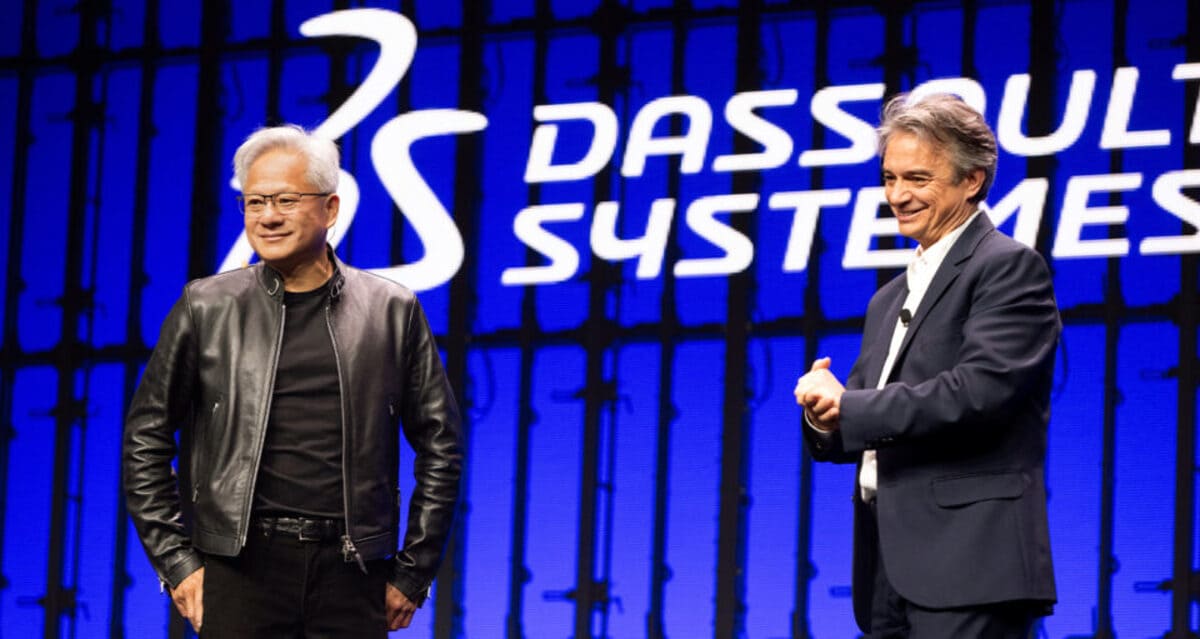
HOUSTON — In a major move to redefine the future of manufacturing and engineering, NVIDIA CEO Jensen Huang and Dassault Systèmes CEO Pascal Daloz have announced a landmark partnership to build a shared industrial AI architecture. Speaking at the 3DEXPERIENCE World event, the executives detailed a blueprint for the next generation of industry, rooted in physics-based “world models” designed to simulate everything from biological systems to entire factories before they are physically constructed.
A New Era of Digital Infrastructure
Huang described the rise of artificial intelligence as the emergence of a new form of infrastructure, comparing its necessity to water, electricity, and the internet. The partnership, which marks the largest collaboration between the two companies in over 25 years, aims to fuse NVIDIA’s accelerated computing with Dassault Systèmes’ Virtual Twin platforms.
According to the sources, this fusion is intended to allow engineers to work at a scale 100 times to eventually a million times greater than previously possible. By moving engineering workflows into real-time, AI-powered digital environments, teams can explore and validate designs faster through AI companions.
From Digital Models to “Knowledge Factories”
The collaboration shifts the focus from traditional digital designs to systems that can generate and optimize in software at an industrial scale. Daloz emphasized that virtual twins are no longer just applications but have evolved into “knowledge factories” where information is created, tested, and trusted upstream of physical production.
Also Read
[ New Research: AI Authenticity Crisis Threatens to Cannibalize Social Media’s Core Business Model ]
[ From Novel to Transmedia IP: Robojit’s AI-Assisted Production Pipeline ]
[ Technology Brief: The Expanding Sphere of AI — From National Strategy to Daily Interaction ]
This architecture will be applied across several key sectors:
- Biology and Materials: Utilizing the NVIDIA BioNeMo platform to accelerate the discovery of new molecules.
- Design and Engineering: Using AI-based physics libraries to instantly predict outcomes and behavior.
- Autonomous Manufacturing: Integrating NVIDIA Omniverse with the DELMIA Virtual Twin to create software-defined production systems.
- Virtual Companions: Deploying an agentic platform that provides engineers with actionable intelligence grounded in deep industrial context.
Global AI Factories and Human Amplification
To support these advancements, Dassault Systèmes is deploying NVIDIA-powered AI factories across three continents. These will run on the OUTSCALE sovereign cloud, allowing customers to process massive AI workloads while meeting strict data residency and security requirements.
Despite the heavy focus on automation and AI, both leaders stressed that the technology is intended to amplify human creativity rather than replace it. Huang noted that every designer will eventually be supported by a “team of companions” to handle repetitive tasks, providing more leverage for creative problem-solving.
As Daloz concluded, the goal is not to automate the past, but to provide engineers with the tools to “invent the future” by eliminating costly mistakes in the virtual world before they reach the physical one.
Meanwhile, in a major move to solidify the future of AI infrastructure, Huang confirmed recently that his company will participate in OpenAI’s latest funding round, describing the commitment as potentially the “largest investment we’ve ever made”.